What were you looking for when you first encountered Focusing? When we learn Focusing, we soon discover that it is not simply the 6 steps Gendlin described in his first book.
So, what is it? What do those steps point towards?
For me, the story of Focusing is not mainly the history of the Focusing community, nor the evolution of Gendlin’s philosophy, nor the development of different Focusing teaching styles.
I see ‘Focusing’ as the story of many thousands of individuals who have adopted this practice as their way of being. I think it is how we live Focusing that shows the potential of what this practice can be in the world. And importantly, that our Focusing way of being might begin years before we actually learn the practice of Focusing!
My own story begins in a small prairie town in western Canada. It would take a lifetime to understand how my earliest years shaped me. Shaped not only through the people and the events, but through something much more subtle and implicit.
Afternoons playing in the summer sun.
Walking through a grassy field, stiff from the overnight frost.
Watching ponds come alive in spring.
Looking at the night sky through a bedroom window.
These moments are rarely spoken about because they seem so ordinary. Yet they make up the vast majority of who I know myself to be. They may be more formative than any single dramatic event, trauma or peak experience.
Like the physical landscape I grew up in, these moments are the substrate of my being-in-the-world. Years later, when I formally learned Focusing, these kinds of moments would return — images drifting into awareness when I stayed with a felt sense.
Often with a positive feeling of nostalgia, melancholy, a sense of coming home.
Learning Focusing is often experienced as a coming home. Home to what? Perhaps to the quiet current of living itself – so close to us that it moves unseen beneath our awareness, like a breath that has no name. A self that builds itself constantly, out of millions of fleeting moments.
Home to a self in perpetual becoming.
I’d like to pause here and invite you to remember an ordinary moment from your own childhood.
Recall any moment that felt beautiful to you as a child. Perhaps a moment no one else knows about. A memory that seems like nothing special.
Perhaps a moment when your small life made sense … and you felt you belonged to the world.
Do moments like this feel like they matter — even if you cannot say how? Welcoming the felt sense of meaning might be more important than knowing what that meaning is.
Focusing is not just a problem‑solving method practised in partnerships – not just a therapeutic technique. It is a reconnection to the subtle, everyday process of our existence on earth, from the beginning and throughout our whole life ….
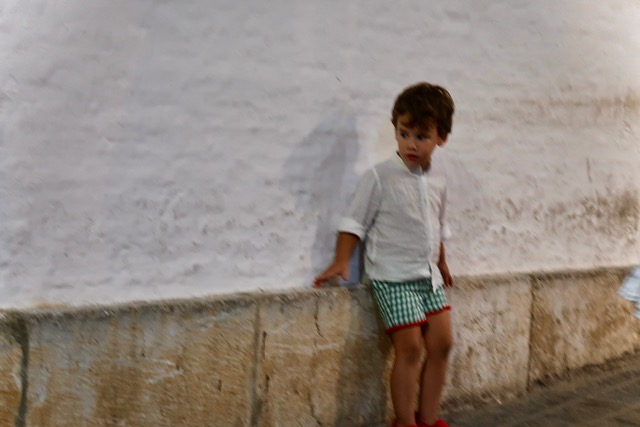
Often, when I focus, I have an early memory of standing on a street corner near a river valley. Nothing happens. I’m just standing there, on my own. It is not a peak experience, yet it feels so significant.
From childhood onwards, living includes so many ordinary moments that feel naturally exquisite, yet stay private, because there are no public words to share them. As children we are already more naturally attuned in our way of being. Learning Focusing returns us home to that openness.
Perhaps these everyday moments are just as formative as the caregiver attachments we assume are so significant. What are children doing when it looks like they are doing nothing?
When we later learn Focusing, it allows us to finally speak about some of these childhood experiences — and even to question some of the basic assumptions that formed around them.
My first encounter with Focusing happened in 1981 when my psychology professor gave me a copy of Gendlin’s Focusing book. The book encouraged me to return to trusting my felt experience — to protect it from authorities, theories, beliefs, even from my own critical thinking. Although I was barely twenty years old, I was already trying to lock myself into an orthodox life plan. But Gendlin’s words encouraged me to trust all those caged bodily feelings. He told me that they could actually guide me in life.
No one had suggested that to me before. Since childhood, no one had been so unconditionally on my side. What I found when I listened inwardly was not so dangerous that it needed to be kept in captivity. I found a wise human animal. It felt young. It felt wary from its mistreatment, but deeply intelligent. Much wiser than the so-called ‘grown-ups’ or the part of me that was already trying to be like them.
Focusing can help us find a childlike openness again, a natural flow of experiencing, offering access to all the richness of detail that elaborates us constantly, and to the impulse from life to live it fully, each in our own unique way.
28 Jul, 2026
Dr Greg Madison
London Focusing Faculty